Blog
-
A 4th of July Tribute (Part 1/2)
Each year on the 4th of July, I take some time away from cookouts, fireworks, and my family to spend a few moments with my favorite firearm. I sit alone in my gunroom, reflecting upon the one piece in my collection that for me most embodies Independence Day. It doesn’t have a gas cylinder, it isn’t even Parkerized. It isn’t a mint, perfect example; in fact it is probably the worst condition piece in my collection. It is a well-used Model 1763 Charleville flintlock musket, which features a branded “U STATES” surcharge and three sets of initials carved into the stock. Both sling swivels have been removed and the studs…
-
My Favorite M1 Carbines (Part 2/2)
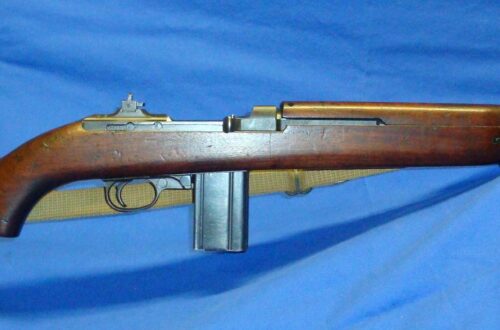
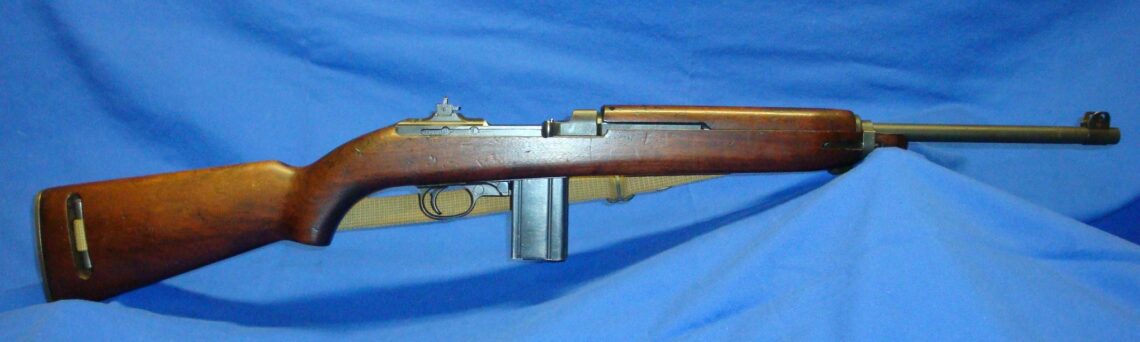
This Blog post is on my Inland M1A1 carbine. The M1A1 carbine was a modification to the M1 carbine that replaced the standard stock with one that folded and was intended for issue to newly formed airborne troops. Many paratroopers were issued the M1A1 carbine for jumps into combat. Those paratroopers included my father-in-law. As I related in my Foreword to our book “The M1 Carbine Owner’s Guide” I wanted an M1A1 carbine in my collection because: Most of us know someone who carried a Carbine in World War II, Korea, or Vietnam. There is often an emotional tie. For me it is my father-in-law, Thomas Shoen, Jr. (11th Airborne…
-
My Favorite M1 Carbines (Part 1/2)
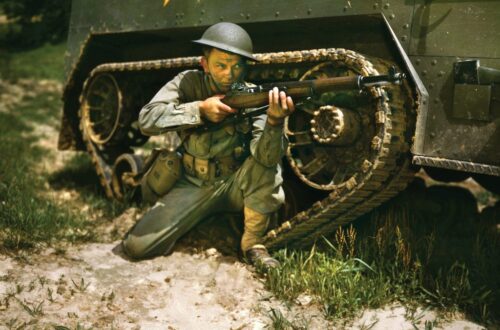
This post is my second about my favorite World War II US arms. The following paragraph is repeated from my earlier Blog post entitled “My Favorite M1 Garand.” As a researcher and serious student of American history I like comparative technological study. Therefore, my theme for World War II focuses on the year 1943. By 1943 the primary US arms were well developed and production was at or nearing its peak. Americans were engaged in combat against the Axis powers around the world. My World War II collection includes 1943 manufactured arms: an SA and WRA M1 rifle, an Inland M1 and M1A1 carbine, a Colt M1911A1, and so on. …
-
We Wish They Could Talk – Sometimes They Do (Part 1/2)
Over the many decades I have been a collector and dealer of US martial arms, I have often heard fellow collectors say “I wish this rifle (or pistol) could talk.” Or “I wonder who carried it and where it has been.” In a few very rare cases we have been able to answer at least part of those questions. The 30 Guam Garands are one unique example. These 30 M1 rifles were given to the Guam Security Patrol Force after the battle in 1944 and eventually ended up with the Guam Police Department. In 1994 that Department wanted to update their inventory of small arms. A trade was made with…
-
More Super .38 Shenanigans: The Pachmayr-Tussey-Patton Pistol
More Super .38 Shenanigans: The Pachmayr-Tussey-Patton Pistol Colt Super .38 Some years ago, whilst researching “The M1911 Complete Owner’s Guide,” I came across a Pachmayr custom M1911 in .22 Long Rifle. It was built with a .22/.45 Conversion Unit. Nothing particularly puzzling there, except for one nagging question: what was the source of the frame? Clearly, the frame was produced prior to 1968, at a time when, while the serial number (if present) of American-manufactured firearms was to be marked on the frame or receiver, the manufacturer was free to place the company name and address and model name anywhere it chose. In the case of automatic pistols,…
-
10/22 Deja Vu
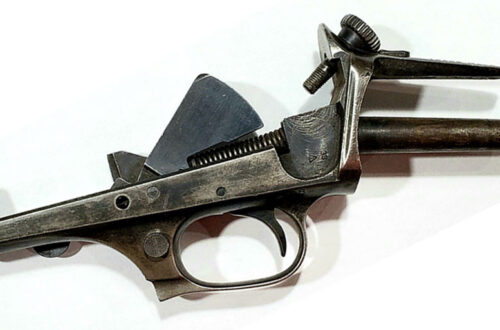
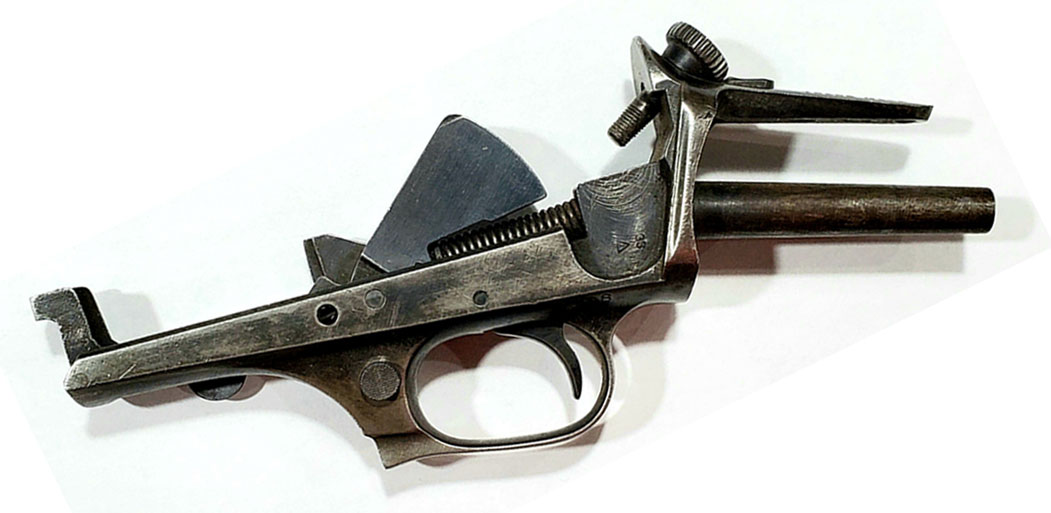
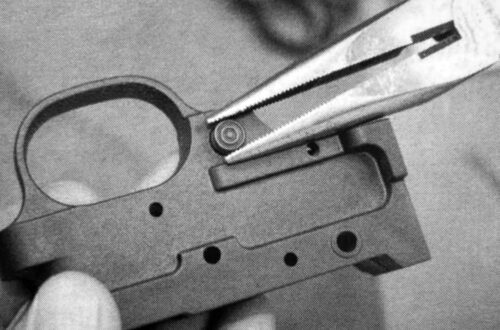
You’ll have to read the text to find out what this is… Here’s a question for you: what is this that is pictured above? Take your time; I’ll wait… Got it? Or not? Anyway, it’s the trigger assembly from a Winchester Model of 1905. The Win ’05, as it is commonly termed, is a long-recoil autoloading rifle developed by Tom Johnson and introduced, presumably, in 1905. Now that you know what it is, here’s a second question: why is it the subject of a blog post here? After all, we’ve never done anything on the Win ’05. Take your time to answer; I’ll wait… It’s here because it’s the direct…
-
Why did we build two pistols for “The M1911 Complete Assembly Guide”?
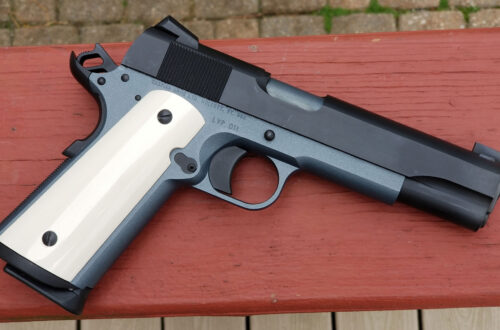
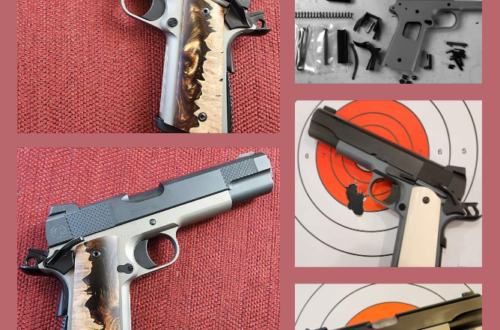
Why did we build two pistols for “The M1911 Complete Assembly Guide”? WJK M1911, the second pistol from “The M1911 Complete Assembly Guide” In “Retro” mode When we began working on “The M1911 Complete Assembly Guide” the first order of business was to complete the pistol begun during Larry Vickers’ build class, “LVP 011.” We’ve told that story in a previous post. What might not be obvious to the casual observer is that we, or rather, I, actually built two pistols for the book. What also might not be obvious is why I built two M1911s. After all, wouldn’t one pistol suffice to illustrate the build process and be…
-
The Story behind “The M1911 Complete Assembly Guide”
When one decides to write a book, the path may be straight and narrow. Get an idea, do the research, write the words. Fiction or non-fiction, that’s the way it often goes. Sometimes, though, the path to a book is not so direct. That was the case with “The M1911 Complete Assembly Guide.” Back in 2007, I got the idea to write a book on the Model of 1911 pistol. As is my usual plan of attack, despite having at that time some forty-seven years of experience with M1911s, I began a deep dive into the history and function of Browning’s masterpiece. I can recall in 1960, when I acquired…
-
Ruger SP101
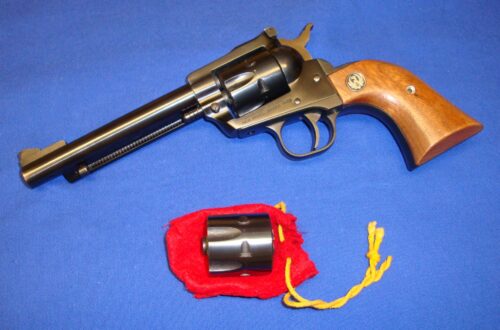
This week’s Thursday Day at the Range features something new to the series, a Ruger SP101 revolver. However, there’s a familiar twist; it’s chambered in “9mm Parabellum.” Yep, another 9x19mm handgun, but this time a wheelgun. The SP101 was introduced in 1989 by Ruger to fill out their product line with a J-Frame class snubby, albeit with Ruger rugged reliability. If memory serves, the initial version of the SP101 had a cylinder frame that limited the .357 Magnum version to an overall length that permitted cartridges only with 125-grain bullets or lighter. Skeeter Skelton and/or Massad Ayoob prevailed on Bill Ruger to lengthen the frame so that a cylinder suited for…
-
Barrel Usage on New M1 Rifle ’52-’57 Harrington & Richardson Arms Co. (Part 3/3)
Barrel Usage on New M1 Rifle Production 1952 – 1957 Harrington & Richardson Arms Company – Part 3 of 3 Harrington &Richardson Arms Co. had a barrel contract that predated their rifle contract. Therefore, it is not uncommon to find original HRA riles with early 1952 dated barrels. The vast majority of Harrington & Richardson manufactured M1 rifles were assembled with HRA barrels. However, research indicates that H&R used LMR barrels, at least to a limited extent, throughout their entire production of the M1 rifle. Some periods saw heavier usage than others. The earliest H&R M1 rifles from serial number 4660000 through 46625xx were generally equipped with HRA barrels. Only…