-
Barrel Usage on New M1 Rifle ’52-’57 Intl. Harvester Co.(Part 2/3)
Barrel Usage on New M1 Rifle Production 1952 – 1957 International Harvester Company – Part 2 of 3 Most M1 Garand collectors know that International Harvester M1s were assembled with barrels made by Line Material of Birmingham, Alabama. These barrels are marked LMR and dated with the month and year of manufacture. However, like M1s built at Springfield, not all IHC M1s used the expected LMR barrel. During two specific periods IHC assembled rifles using SA barrels. The exact reason is unknown, but one would assume it was due to some delay in barrel manufacture and delivery by Line Material. The first time was in the 444xxxx serial number range…
-
Barrel Usage on New M1 Rifle ’52-’57 (Part 1 of 3)
During World War II with few exceptions, new Springfield Armory M1 rifles were assembled using Springfield Armory manufactured barrels and Winchester Repeating Arms M1 rifles were assembled using Winchester barrels. With the much lower production rate in the 1950s collectors would expect the same of Springfield Armory, International Harvester and Harrington & Richardson. However, this was not the case. This is the first of a three-part series covering barrels used to assemble new M1 rifles produced from 1952 to 1957. This article is on Springfield Armory. The second will detail barrels used by International Harvester. The third will be on Harrington & Richardson production. Early post World War II Springfield…
-
The Ageless 10/22
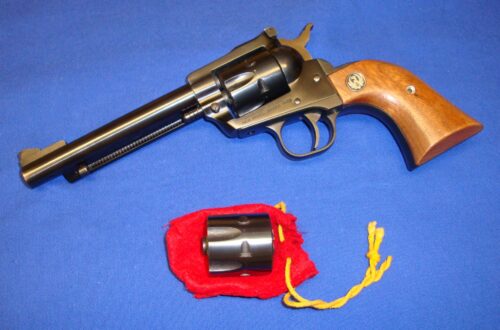
It’s October of 2020, so the 22nd must be National 10/22 Day! If you have a 10/22, be sure to bring it out and shoot it. If you don’t have a 10/22…wait, doesn’t everyone have a 10/22? Anyway, perhaps it would be a good day to get a 10/22. The 10/22 is truly a phenomenon in the gun industry. It is one of the few firearms of which we are aware that has not gone through any fundamental design changes in all these years and millions of units. Oh sure, the receiver finishes have changed, and the original three models, rifle, sporter and International, have permutated into literally hundreds of…
-
Lowest & Highest Serial Number M1s (Part 2/2)
Lowest & Highest Serial Number M1s – Part 2 By Scott A. Duff 9-10-20 There had long been a question of what was the highest serial number M1. Director of Civilian Marksmanship (DCM), the predecessor of the CMP, had sales records that indicated a high s/n of 6100499. However, no collector had reported seeing this rifle, so some doubt remained. In May of 2001 to my surprise I was contacted by the owner of M1 rifle s/n 6100499 seeking an appraisal. A careful analysis and appraisal was based upon a telephone interview with the owner, numerous color photographs, and a photocopy of the original DCM Requisition and Invoice/Shipping Document (DD…
-
Lowest & Highest Serial Number M1s (Part 1/2)
Many gun collectors are interested in the lowest and highest serial number firearms of the model in which they are interested. Collectors of the M1 rifle are not an exception. With that in mind, a brief summary on the earliest M1 rifles is in order. The goal of the US Army’s Ordnance Department to develop a semi-automatic service rifle began in the early part of the 20th century. John Garand was one of many inventors trying to accomplish this goal. In 1919 he was appointed to work on development of a semi-automatic rifle at the government’s Springfield Armory located in Springfield, MA. In 1932, as a result of tests conducted…
-
The Eddystone Story
The Eddystone Story By Walter J. Kuleck, Ph.D. The war activities of the Baldwin Locomotive Works also included the construction of two large plants on their property at Eddystone for the manufacture of rifles and ammunition, and accomplishments in this connection constitute a series of achievements worthy of record. On April 30, 1915, the British Government placed a contract with the Remington Arms Company of Delaware for 1,500,000 rifles to be manufactured in one of the plants mentioned above, under the general direction of Mr. S. M. Vauclain. The work of constructing equipping and organizing this enormous plant was fully accomplished, and production established by December 31, 1915,…
-
THE GUAM GARANDS
THE GUAM GARANDS Introduction In all military conflicts, the price of an objective is paid with the lives of combatants. Historically it has been considered that the force armed with superior weapons incurs fewer casualties and has a greater chance of victory. For this reason tacticians and military historians have studied small arms for centuries. As the appreciation for the development of small arms grew, and people began to accumulate these pieces of history into collections, so did the interest in where and how they may have been used. As the conflict or event passes further into history, and we begin to rely more upon what is written in the…
-
Guam Garand Monograph
Guam Garand Monograph – The full story of the Guam Garands is told along with 30 data sheets on these original circa 1944 M1 rifles. Don’t miss the opportunity to have data sheets on 30 verified World War II battle rifles. Introduction In all military conflicts, the price of an objective is paid with the lives of combatants. Historically it has been considered that the force armed with superior weapons incurs fewer casualties and has a greater chance of victory. For this reason tacticians and military historians have studied small arms for centuries. As the appreciation for the development of small arms grew, and people began to accumulate these pieces…
You May Also Like

We Wish They Could Talk – Sometimes They Do (Part 1/2)
-
The M1C Sniper Rifle
The M1C Sniper Rifle by Scott A. Duff Two telescope-mounted versions of the M1 rifle were developed at Springfield Armory for use by snipers. They were designated the M1C and M1D. The M1C was adopted as standard on 27 July 1944. A Lyman produced M81 or M82 telescope was mounted with a two-piece system consisting of a mount bracket and Griffin & Howe telescope mount. The mount bracket was aligned to the left side of the receiver by two taper pins and attached with three socket head cap screws. Therefore, all M1C rifles had five holes in the left side of the receiver, three were tapped, and two…
-
The M1D Sniper Rifle
The M1D Sniper Rifle by Scott A. Duff Two telescope-mounted versions of the M1 rifle were developed at Springfield Armory for use by snipers. They were designated the M1C and M1D. The M1D was adopted as substitute standard in September 1944. The M1D utilized a machined base fitted around the chamber end of the barrel and secured with a pin to attach the telescope mount. There is no evidence that M1Ds were produced for distribution during World War II. Further, other than a few rifles used during development, it is believed that all M1Ds were created by rebuilding existing service rifles beginning in the early 1950s and continuing through…