Three Icons of American Firepower
The Ruger, M1 Garand, and M1911 — a century of engineering excellence that defined how America shoots.
Featured above: John Moses Browning, legendary firearms designer.
Few hobbies connect us so directly to American history as owning and shooting classic firearms. Three guns stand above the rest in terms of legacy, mechanical ingenuity, and enduring passion among collectors — the Ruger family, the legendary M1 Garand, and the timeless M1911. Whether you’re a seasoned collector with a climate-controlled safe full of blued steel, or a newcomer drawn in by the romance of a piece of history, these three platforms offer something extraordinary: they reward study. The more you learn, the more you appreciate them.
01 — THE RUGER LEGACY American Original
Bill Ruger founded Sturm, Ruger & Co. in 1949 on the premise that American shooters deserved affordable, well-made firearms built right here at home. Starting with a modest .22 semi-auto pistol, Ruger grew into one of the largest domestic firearms manufacturers in the United States — and did it without ever losing sight of what shooters actually wanted.
The Ruger 10/22 — America’s Rifle Introduced in 1964, the 10/22 is arguably the most customized firearm in American history. Its rotary magazine, simple takedown design, and rock-solid reliability made it the go-to rifle for everything from pest control to competitive rimfire shooting. The aftermarket support is staggering — stocks, triggers, barrels, optics mounts — the 10/22 is practically a platform unto itself.
Single-Action Revolvers The Ruger Single Six and Blackhawk lines brought single-action revolver reliability to a new generation. Where Colt’s original Single Action Army had become a collector’s piece, Ruger’s adaptations were working guns with modern metallurgy. The transfer-bar safety in later models made them far safer to carry with a full cylinder — a genuine engineering improvement over the classic design.
What Makes Rugers Special to Collectors Ruger produced a number of limited-edition and commemorative models throughout its history, including special-run Blackhawks, collector Single Sixes with antique finishes, and factory-engraved pieces. Early “pre-warning” models — before safety warnings were added to frames in the late 1970s — are particularly sought after for their clean aesthetics and historical significance.
02 — THE M1 GARAND The Rifle That Won a War
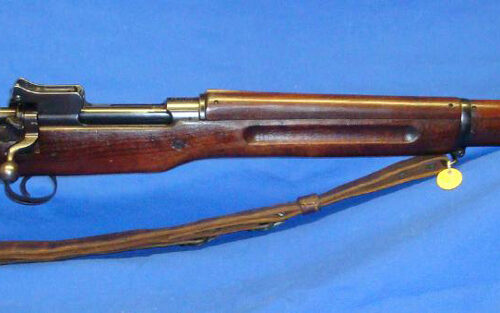
General George S. Patton called it “the greatest battle implement ever devised.” John Cantius Garand, a Canadian-born engineer working at Springfield Armory, spent nearly a decade perfecting the design that became standard issue for the United States military in 1936. What made it revolutionary wasn’t just the semi-automatic action — it was the elegance of a gas-operated, en-bloc clip-fed system that a muddy, exhausted soldier could operate reliably under the worst conditions imaginable.
Understanding the En-Bloc Clip The Garand’s distinctive en-bloc clip holds eight rounds of .30-06 and loads into the receiver as a single unit. When the last round is fired, the clip ejects with the now-famous metallic “ping” — a sound beloved by enthusiasts. Loading and unloading the Garand is a skill worth mastering; thumb injuries from improper loading — “Garand thumb” — are a rite of passage best avoided with proper technique.
Variations Collectors Seek Garands were manufactured by Springfield Armory, Winchester, International Harvester, and several other contractors throughout World War II and into the Korean War era. Matching receiver, barrel, and stock combinations from the same manufacturer and period command significant premiums. Gas trap models from 1937–1940 are exceptionally rare and represent the earliest production examples of a still-evolving rifle.
Shooting the Garand Today The Civilian Marksmanship Program (CMP) has long been the go-to source for surplus Garands, and competitive shooting through CMP and NRA-sanctioned matches keeps the tradition alive. One important note for modern shooters: the Garand’s operating rod is designed for standard-pressure .30-06 loads. Modern commercial ammunition with higher pressures can damage the op-rod over time — always use GI-spec or approved loads, or invest in an adjustable gas plug.
03 — THE M1911 The Pistol That Defined an Era
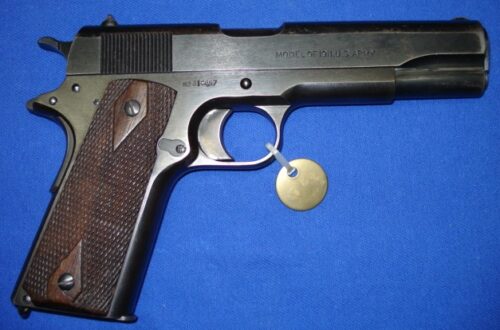
John Moses Browning was perhaps the most prolific firearms designer in history, and the M1911 stands as his masterpiece. Adopted by the U.S. military following trials prompted by the inadequacy of the .38 Long Colt against Moro warriors in the Philippines, the 1911 in .45 ACP served American soldiers through two World Wars, Korea, Vietnam, and beyond — holding official U.S. military service from 1911 until 1986, a seventy-five year run unmatched by any sidearm in American history.
The Genius of Browning’s Design The locked-breech, tilting-barrel short-recoil system Browning developed remains the basis for the vast majority of semi-automatic pistols manufactured today. The grip angle, the single-action trigger with its crisp consistent break, and the thumb safety enabling “cocked and locked” carry — these were not happy accidents. They were deliberate choices by a designer who understood both mechanics and the human hand.
Collector Variations: A Deep Rabbit Hole The earliest Colt-manufactured examples from 1912–1913 are among the most desirable. WWI “Black Army” pistols showing authentic holster wear carry tremendous historical resonance. WWII-era pistols from Remington Rand, Ithaca, Union Switch & Signal, and Singer are eagerly sought — with Singer examples being exceptionally rare and valuable. The A1 variant introduced in 1924 brought a revised hammer, arched mainspring housing, and shortened trigger, changes that remain divisive among purists to this day.
The 1911 Today The 1911 platform remains one of the most customized pistols in the world. From bone-stock GI-configuration pistols to fully tricked-out competition guns, the 1911 rewards personal expression as much as historical study. Manufacturers from Colt to Wilson Combat to Springfield Armory continue producing them because the demand never fades. No pistol has been analyzed, debated, customized, and loved more. It remains the standard against which every other service pistol is still judged.
GO DEEPER INTO THE BOOK COLLECTION
For the serious collector and enthusiast, there is no substitute for authoritative reference material. Scott Duff has spent decades producing the definitive books and resources on American military firearms — particularly the M1 Garand and M1911. His publications cover complete serial number guides, contractor identification, value references, and maintenance resources that no enthusiast’s library should be without. Whether you’re authenticating a potential purchase, researching the provenance of a family heirloom, or simply deepening your knowledge, it’s all waiting for you at scott-duff.com.